Your baby’s sleep,
one day at a time
Suggested nap times, daily plans and gentle reminders
Track sleep and feeds from birth to age 3
See suggested nap times based on your baby’s age and logged sleepTrack sleep and feeds in a diary you can share with your co-parentAsk the AI assistant about your logged day. It is not a substitute for medical advice
NapCoach AI is a baby care assistant that uses the information you log about your child. Developed with support from:



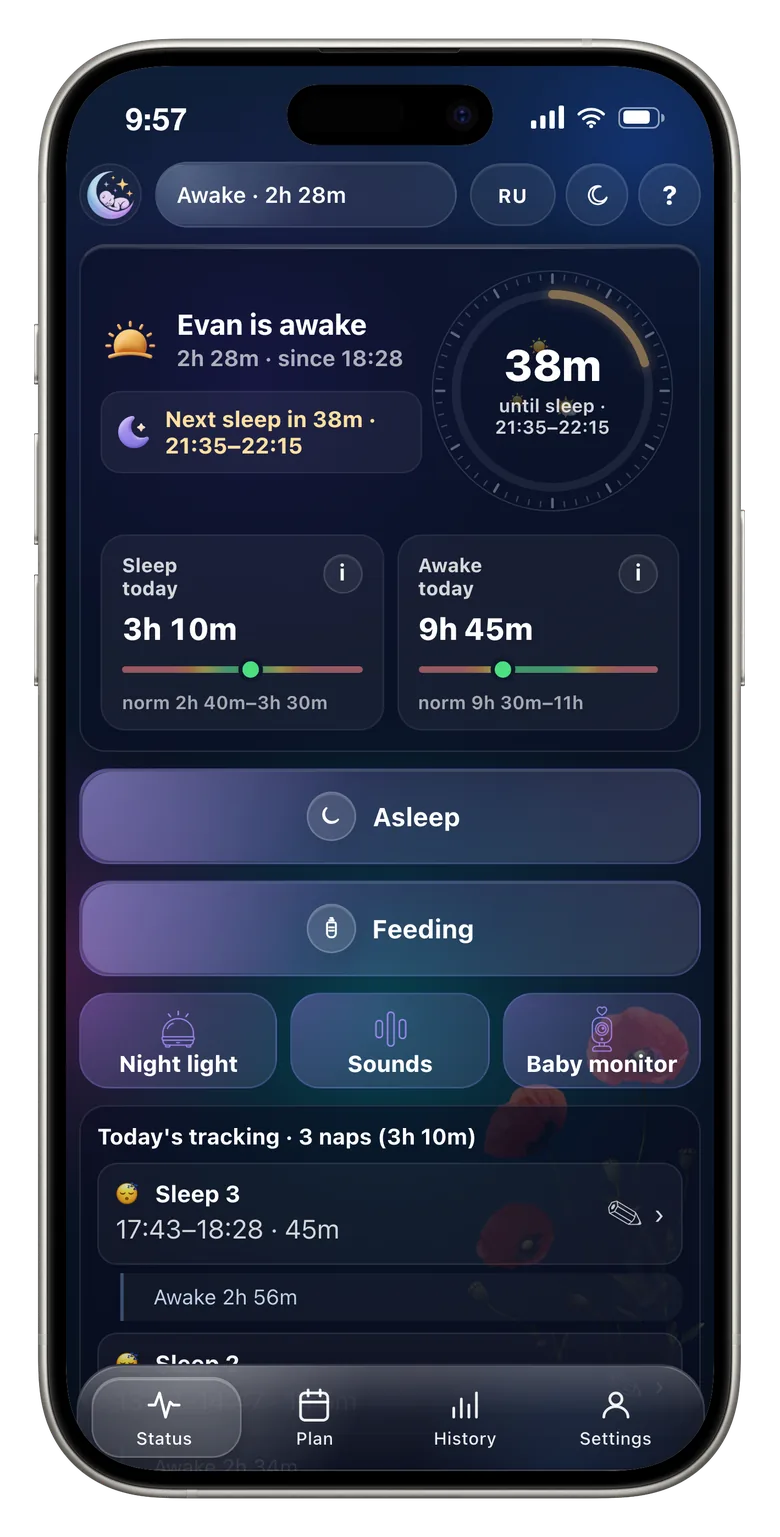


NapCoach guides the day step by step
It does more than log sleep. It guides the day: shows the next step, updates the plan after every event, and keeps both parents in the same context

Plan your baby’s next nap
NapCoach uses age in weeks, the latest wake-up and logged sleep to suggest when to start the routine. Adjust to your baby’s cues.

Rebuilds the day after every event
Fell asleep, woke up, fed again, and the app instantly recalculates the next nap, a bridge nap, routine timing, and the bedtime target.

Reminders around suggested nap times
First a gentle heads-up, then a clear "time to put baby down". Keep only the alerts you want and set quiet hours.

Answers from your baby's real data
Ask about short naps, bedtime, or whether a bridge nap makes sense. The reply uses your sleep and feeding history, not generic parenting advice.

Brings day, week, and month into one picture
See today, 7-day and 30-day views, norm comparisons, and Excel export. You understand what is really changing instead of guessing from one rough night.

Keeps both parents in the same context
When one parent logs an event, the other sees the updated status, plan, and history right away without retelling or screenshots.
Wake Windows by Age
The time a baby can stay awake without becoming overtired changes with age every few weeks. Below are simplified ranges, and within each age the app calculates precise norms by week.
Consensus Sleep Guidelines (24h)
AASM 2016, endorsed by AAP
- 4–12 months: 12–16 h/day (including naps)
- 1–2 years: 11–14 h/day
- 3–5 years: 10–13 h/day
What NapCoach Tracks
Based on your baby's age in weeks
- 17 age ranges: from 0 weeks to 3 years
- Wake window: 20–390 minutes
- Total sleep: 15–18 h (newborns) to 11.5–13.5 h (2+ years)
- Nap transitions: 5→4, 4→3, 3→2, 2→1
What Research Confirms
Evidence-based pediatric sleep medicine
- Chronic sleep deprivation in children is linked to worse attention, behavior, learning, and emotional regulation outcomes.
- In infants, sleep patterns are associated with stress system markers (HPA-axis, cortisol).
- That's why both wake window length and schedule consistency matter, not just total sleep hours.
Sources: AASM Child Sleep Duration Advisory, J Clin Sleep Med (2016), J Sleep Res (2021), Dev Psychobiol (2016).
Advice in your baby's context
No more "for babies at 3 months it's recommended...". The app knows how long Arina slept today, when she woke up and what she ate, and responds based on that specific data.
-
Shared sleep history No need to repeat context; the app remembers your recent conversation and the entire tracking history
-
Real data, not templates The prompt always includes: current status, last 24 hours log, weekly stats and age-appropriate norms
-
Practical advice only Specific next steps, no fluff. Medical questions are referred to your pediatrician
Methodology based on AAP/AASM clinical guidelines and pediatric sleep meta-analyses: Mindell et al., Sleep, 2006; Gradisar et al., Pediatrics, 2016.
What do parents say about us?
Real stories from people who use NapCoach AI
"I finally understand when to put him to bed. We used to guess — now the bot gives us advance reminders. Lyova started falling asleep faster, without tears. After three weeks of using it, we started meeting the sleep norms for his age."
"My wife and I use it together: we share the same history, so we don't need to tell each other how long Anya slept. The AI morning briefing and daily schedule are a whole other kind of magic. It really helps us plan the day."
"I messaged the bot at 3 AM about short naps. It replied in detail, taking into account how my son had slept all day. It wasn't a generic answer based on norms and textbooks — it addressed our specific situation. Just wow."
What people say vs. what's actually true
Three persistent misconceptions that prevent better sleep
"If you keep them up longer, they'll get tired and sleep better"
Overtiredness puts the nervous system into an excited state, making it harder to fall asleep and reducing sleep quality. Catching the "window" matters more than waiting.
"Letting them cry it out is harmful to their psyche"
A 5-year study (Price et al., Pediatrics, 2012) found no long-term differences in emotional development or attachment in children who underwent behavioral sleep intervention.
"Internet advice will work just fine"
Template recommendations don't account for age in weeks, accumulated sleep debt, or your child's actual sleep history, the data that NapCoach sees at every moment.
Frequently Asked Questions
Can't find your answer? Reach out and we'll help.
If you want to get oriented first
You can start with a sample day plan and a few practical sleep guides, then move into the app when you want help with your actual day.
Age-based day planner
Enter age, morning wake-up, and bedtime anchor to generate a deterministic baseline day plan.
Open GuideSleep schedule by age
A long-form guide covering wake windows, nap counts, and common transitions.
Open GuideWake windows by age
See how age-based wake windows translate into real-life sleep timing.
Open Guide4-month sleep regression
A focused explanation of what changes around four months and how to adapt the day.
OpenNapCoach AI provides educational information about sleep schedules based on open AAP, AASM recommendations and peer-reviewed research. The service is not a medical device and does not replace pediatrician consultation. Every child is unique, so recommendations are general in nature.
Safe Sleep (AAP): always place your baby on their back, on a separate firm surface without pillows, blankets, bumpers, or toys. For any health concerns, consult your pediatrician.